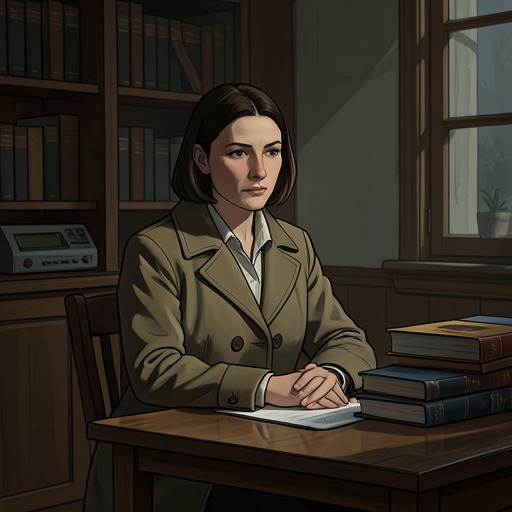
Auden’s lingering distress over her parents’ divorce
Along for the RideAuden’s lingering distress over her parents’ divorce is not a resolved memory but a fear that returns when conflict threatens another family home. For three years she has appeared stoic about her parents’ separation, yet an argument between her father and Heidi brings back the childhood vigilance she had tried to outlast. The episode makes clear that the divorce has shaped both her expectations of family and her habits of solitude, even when she does not consciously dwell on it.
Origin and Childhood Pattern
Auden eventually names keeping her parents together as one of the things she believes she failed at. The admission comes after Eli gives her an easy opportunity not to discuss what happened earlier. Rather than let the subject drop, she recognizes that the question of failure had already brought an answer to mind—one she had not been able to say aloud. Her parents’ divorce therefore remains attached not only to grief but to a child’s sense of responsibility for an outcome she could not control.
The memories that surface are domestic and cumulative rather than centered on a single dramatic scene: awkward dinners, small arguments over picky details, and the unsettled feeling of the house as evening wore on. Auden learned to stretch the night around herself, remaining awake and alert in an effort to keep away the things that frightened her most. The strategy offered vigilance, not safety. In retrospect, she understands that staying awake did not prevent the feared rupture then, and cannot protect her from uncertainty now.
The Present Argument and the Return of Fear
The immediate trigger is overhearing her father and Heidi fight. Auden tells Eli that things have been bumpy since Thisbe arrived and that the conflict has, that night, seemed to erupt. Her reaction is bigger than the present argument alone: she begins to cry and finds herself unable to stop, despite having regarded the old pain as something she no longer thought about. She experiences the tears as a breach in three years of stoicism, and feels humiliated by how quickly that composure gives way.
Her response does not establish that her father and Heidi are separating; it reveals how readily their conflict draws her back to her own family history. Eli suggests that people can argue without splitting up, and recalls that arguments in his family sometimes cleared the air. Auden answers that she knows her father and has seen him do this before. The contrast is between Eli’s possibility of conflict ending in relief and Auden’s expectation that familiar behavior may repeat. When Eli insists that people change, she counters that sometimes they do not. The exchange shows how experience has made reassurance difficult for her to accept, without proving that her fear is correct.
Solitude, Work, and Distance from Others
Auden’s response belongs to a wider pattern of keeping apart from forms of closeness she does not know how to enter. At Clementine’s, she works alone in the office and hears Maggie chatting with customers about jeans, shoes, and clothes. Auden privately dismisses such interests as frivolous and sees Maggie as much like Heidi: feminine, sociable, and content with things Auden considers unimportant. This judgment is not itself evidence that the divorce caused her distance, but it reveals a habit of translating unfamiliar forms of connection into a reason to remain separate.
That distance is made visible again when Auden hears music and women’s voices from the kitchen. She finds Heidi with Maggie, Leah, and Esther, among food and shopping bags, and describes the group’s talk as a kind of melody. From halfway down the stairs, she feels acutely the space between herself and its source; she has spent much of her life listening from that remove. Heidi invites her to join them, making the divide tangible as well as social. The scene places Auden’s isolation beside an available invitation, without suggesting that she has already overcome the habits that keep her apart.
Heidi and the Possibility of Change
Auden’s relationship with Heidi complicates her picture of the family she fears losing. On another evening, she finds Heidi sitting in the dark living room with Thisbe, crying silently. Auden considers leaving the raw, personal moment undisturbed, but knows she cannot simply turn away. She approaches Heidi and offers to take the baby, an act of practical care rather than a demand that Heidi explain herself. The scene shows Auden responding to present distress even as her own fears about family remain unresolved.
Later, when Auden asks why Heidi suddenly seems different, Heidi explains that over the past couple of weeks she has realized she needs time for herself and has discussed it with Karen. This disclosure gives Auden a concrete example of change: Heidi has sought support and begun making room for her own needs. It does not settle Auden’s doubts about her father or erase the earlier divorce, but it sits in tension with her belief that people may remain as they have been.
Meaning and Continuing Effect
The conversation with Eli turns a private reaction into an account of how the past keeps entering the present. Auden’s tears make visible what her long silence concealed; her recollection of night, argument, and watchfulness explains why another household’s conflict feels so charged. The scene does not resolve whether people change or whether the current marriage will endure. Instead, it leaves that question open while showing the cost of treating the past as a reliable forecast.
Auden’s distress is therefore both specific—a daughter’s lingering pain over her parents’ divorce—and part of a larger struggle with uncertainty, connection, and the limits of control. As a child she tried to keep fear at bay by staying awake; now, in Eli’s kitchen, she speaks the failure she had carried silently. Eli’s presence offers a witness rather than a solution: he stands near without touching her, listens as she names what has returned, and leaves the future unsettled. The memory has not disappeared, but Auden has begun to put it into words.